
What Is Root Cause Analysis?
Written by Jason Westland · Edited by Johanna Barnett
In manufacturing quality, root cause analysis (RCA) is a structured investigation that defines the problem, tests possible causes against evidence, establishes the supported occurrence cause and any escape or detection weakness, and provides the basis for corrective action.
RCA is broader than a 5 Whys chain or fishbone diagram. Those methods help organize or test cause paths; the investigation must still show what evidence supports or rules out each possible cause.
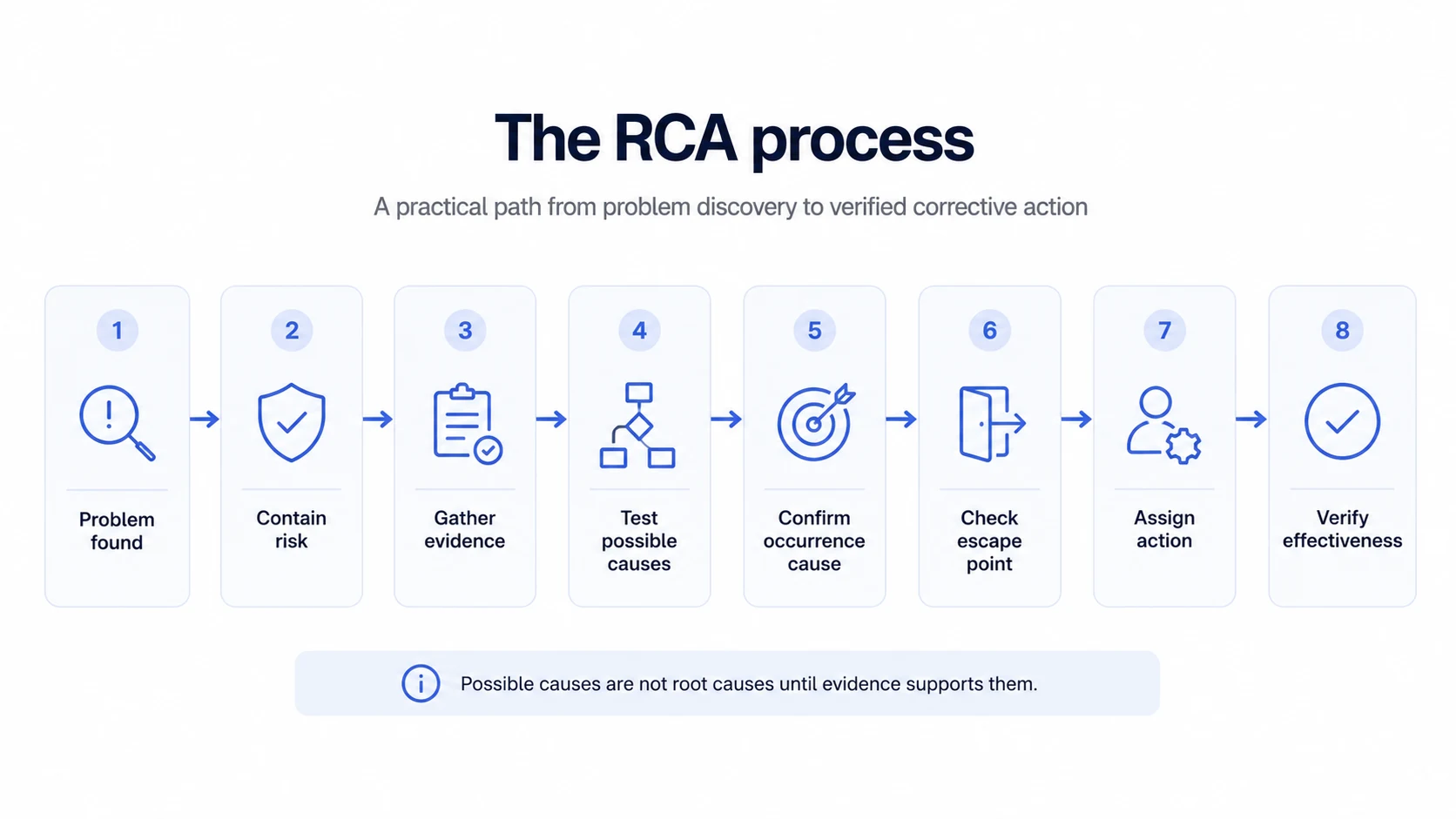
RCA process overview
- 1Define problem and scope
- 2Contain immediate risk
- 3Gather evidence
- 4Map possible causes
- 5Test causes
- 6Establish supported occurrence cause
- 7Establish escape or detection weakness
- 8Document conclusion and next action
What root cause analysis should establish
Root cause analysis should leave an evidence trail that another reviewer can follow. The purpose is to establish the root cause of the problem and any escape or detection weakness with evidence—not to complete a worksheet.
A practical RCA record should show:
- the controlled requirement and actual condition;
- the affected and suspect scope;
- containment and correction references;
- the possible causes considered;
- the evidence reviewed and the result for each cause;
- the supported occurrence cause;
- the escape or detection weakness where relevant;
- the linked corrective action or formal response record.
Do not start with a preferred cause and search for proof. Start with the problem and let the evidence decide which cause paths remain open, which are ruled out, and which conclusion is supported.
When to use root cause analysis—and when a routine record is appropriate
Use RCA when the issue requires a controlled investigation beyond routine correction.
Use RCA when
- the issue is repeated or trending;
- product reached the customer or next process;
- safety, fit, function, shipment, or significant risk is involved;
- the cause is uncertain or disputed, or the available evidence conflicts;
- several functions must agree on the facts;
- a supplier must investigate and respond;
- an NCR, CAR, SCAR, complaint, audit finding, or 8D requires cause evidence;
- a previous correction or corrective action was ineffective.
When a routine correction record is appropriate
Use the smallest controlled record that preserves product status, traceability, ownership, and required approval. A routine production, inspection, maintenance, or correction record may be appropriate when:
- the issue is minor and isolated;
- the condition is already understood and addressed within an approved process;
- no suspect product or external risk remains;
- no special disposition, customer response, or supplier response is required;
- no repeat or trend signal exists;
- the normal record captures correction and verification.
Do not downgrade recurring or escaped issues
The root cause analysis process
A practical RCA moves from a factual problem statement to tested cause evidence, a supported conclusion, and a controlled handoff to the record that owns corrective action.
- 1
Define the problem and scope
State the controlled requirement, actual condition, where the issue was found, and the affected and suspect scope. Include the originating NCR, complaint, audit finding, CAR, SCAR, or 8D where applicable. Keep possible causes out of the problem statement.
Weak problem statement
Operator used the wrong setup.
Stronger problem statement
Final functional test rejected valve assemblies after changeover. The assemblies did not meet the specified flow requirement, and product made since the last verified good changeover remains suspect.
The stronger statement defines the condition and scope without selecting the cause.
- 2
Contain immediate risk
Protect the customer or next process while the investigation continues. Hold affected and suspect product, block release or shipment, check related WIP or finished goods, perform temporary inspection where needed, and identify the clean point.
Record correction and disposition in the originating product record. Containment controls immediate risk; it is not the RCA conclusion or corrective action.
- 3
Gather facts and evidence
Collect the evidence that can distinguish one possible cause from another.
- failed or returned product and photographs;
- the controlled requirement source;
- inspection, measurement, and test records;
- lot, batch, work-order, and shipment traceability;
- setup, machine-setting, maintenance, and calibration records;
- work instructions, control plans, and checklists;
- supplier or customer information;
- interviews and direct process observation.
Collect discriminating evidence
Do not attach every available record by habit. Collect the records, parts, tests, measurements, and observations that can support or rule out the practical cause paths. - 4
Map possible causes
Use a fishbone diagram, 5 Whys, Is/Is Not comparison, process observation, or data review as needed to organize possible cause paths.
At this stage they remain possible causes, not root causes.
- What changed before the issue appeared?
- What differs between affected and conforming product?
- Was the condition present only in the affected scope?
- Could the condition create the observed failure?
- What process control should have prevented it?
- What detection control should have found it?
- 5
Test possible causes and record the result
For each possible cause, record the evidence expected, the evidence actually reviewed, the result, the owner, and any remaining check.
- supported;
- ruled out;
- still open.
“No evidence found” is not the same as ruled out. A cause is ruled out only when the reviewed evidence contradicts it or shows that it does not explain the affected condition.
Do not choose corrective action yet
Do not move to corrective action while material possible causes remain untested or the proposed conclusion is contradicted by affected-versus-conforming evidence. - 6
Establish the supported occurrence cause
The supported occurrence cause is the evidence-backed process condition that allowed the nonconformance to occur.
Weak occurrence cause
Operator selected the wrong setup.
Stronger occurrence cause
The controlled setup instruction did not distinguish the required fixture stop position after changeover, and the fixture could be locked in the previous position without a positive stop.
The stronger conclusion must be supported by the setup instruction, fixture observation, affected-versus-conforming comparison, and reproduction or other credible process evidence.
- 7
Establish the escape or detection weakness
For a downstream or customer escape, determine which control should have detected the condition and why it did not.
Stronger example: First-piece inspection verified visual and torque characteristics but did not require functional flow verification before continued production.
The occurrence cause and detection weakness may require separate actions. Do not combine them into one vague conclusion.
- 8
Document the conclusion and linked next action
Record the supported occurrence cause, escape or detection weakness, evidence reviewed, ruled-out causes, unresolved questions, approval, and the record that owns corrective action.
RCA establishes the cause. Corrective action changes the process or control associated with that cause and owns implementation verification and effectiveness review.
RCA completion is not action effectiveness
The RCA investigation may be approved when the cause evidence, review decision, and linked-action handoff are complete if the site procedure separates investigation closure from action closure. Do not mark the corrective action effective until the defined review criterion is met. If one record owns both stages, keep it open until its closure conditions are satisfied.
How to test possible causes with evidence
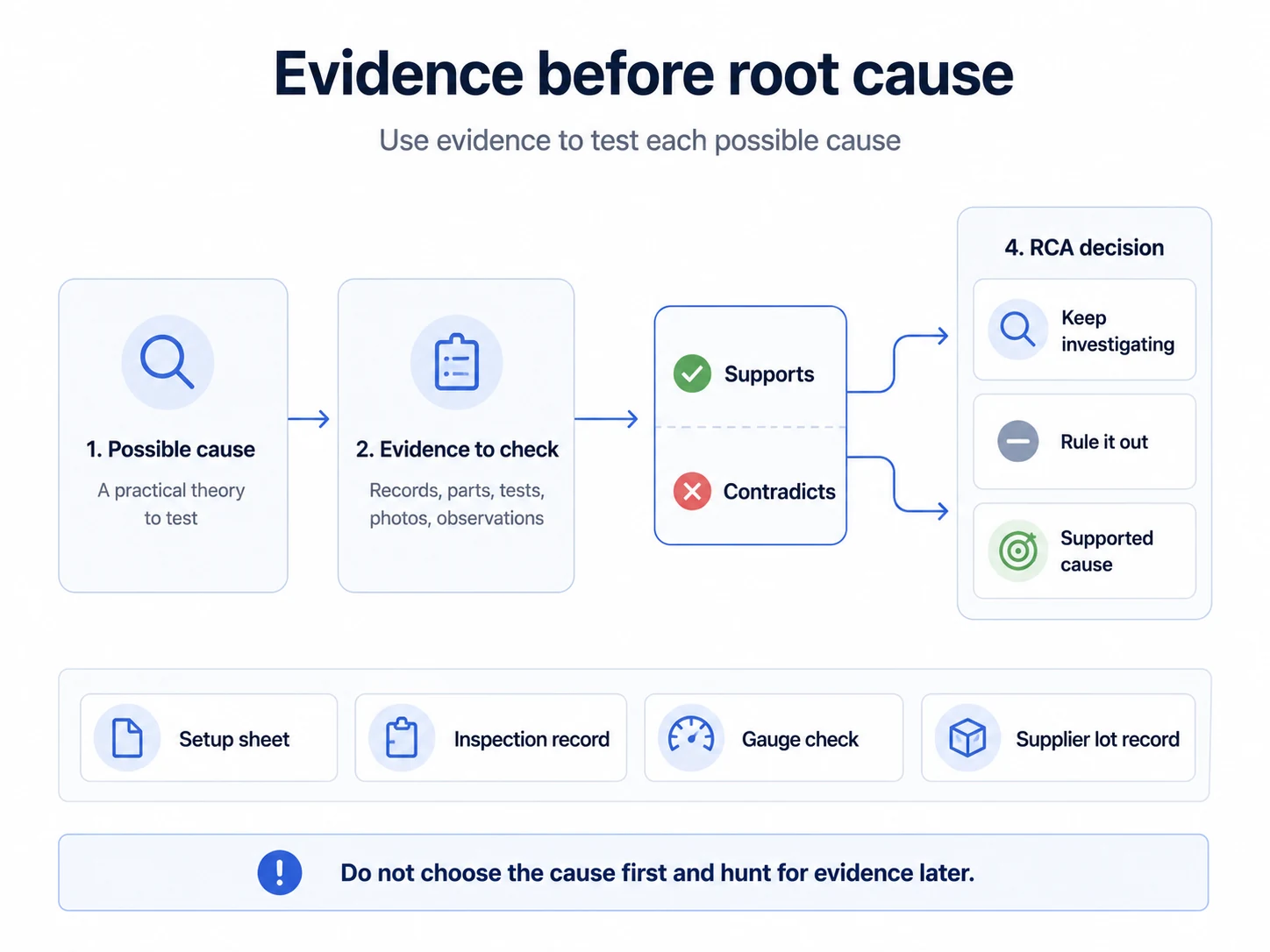
A root cause analysis diagram can organize cause paths, but the evidence record explains why each path is supported, ruled out, or still open.
| Possible cause | Evidence to review | What would support it | What would rule it out |
|---|---|---|---|
| Incorrect setup position | Controlled setup instruction, fixture observation, first-piece record, and affected-versus-conforming comparison. | The alternate position was available after changeover and reproduces the observed failure condition. | The verified setup was identical for affected and conforming product and does not reproduce the condition. |
| Test-equipment drift | Calibration status, master check, repeated test, and independent comparison. | The equipment fails the master check or produces a repeatable bias consistent with the failure. | The equipment passes before and after the event and an independent test agrees. |
| Supplier-component variation | Lot traceability, incoming inspection, component comparison, and requirement evidence. | The failure follows one component condition and can be reproduced with affected material. | The same component lot is present in conforming product and the component meets the requirement. |
| Unclear work instruction | Released instruction, revision history, interviews, and direct process observation. | The instruction permits more than one interpretation and actual practice varies. | The instruction is unambiguous and the observed process follows it consistently. |
Use one result for every cause path: supported, ruled out, or still open. Do not convert an unchecked theory into the root cause of the problem.
Occurrence cause and escape or detection weakness
When the issue reached a downstream process or customer, RCA must answer two separate questions: what allowed the nonconformance to occur, and what allowed it to pass the expected detection point.
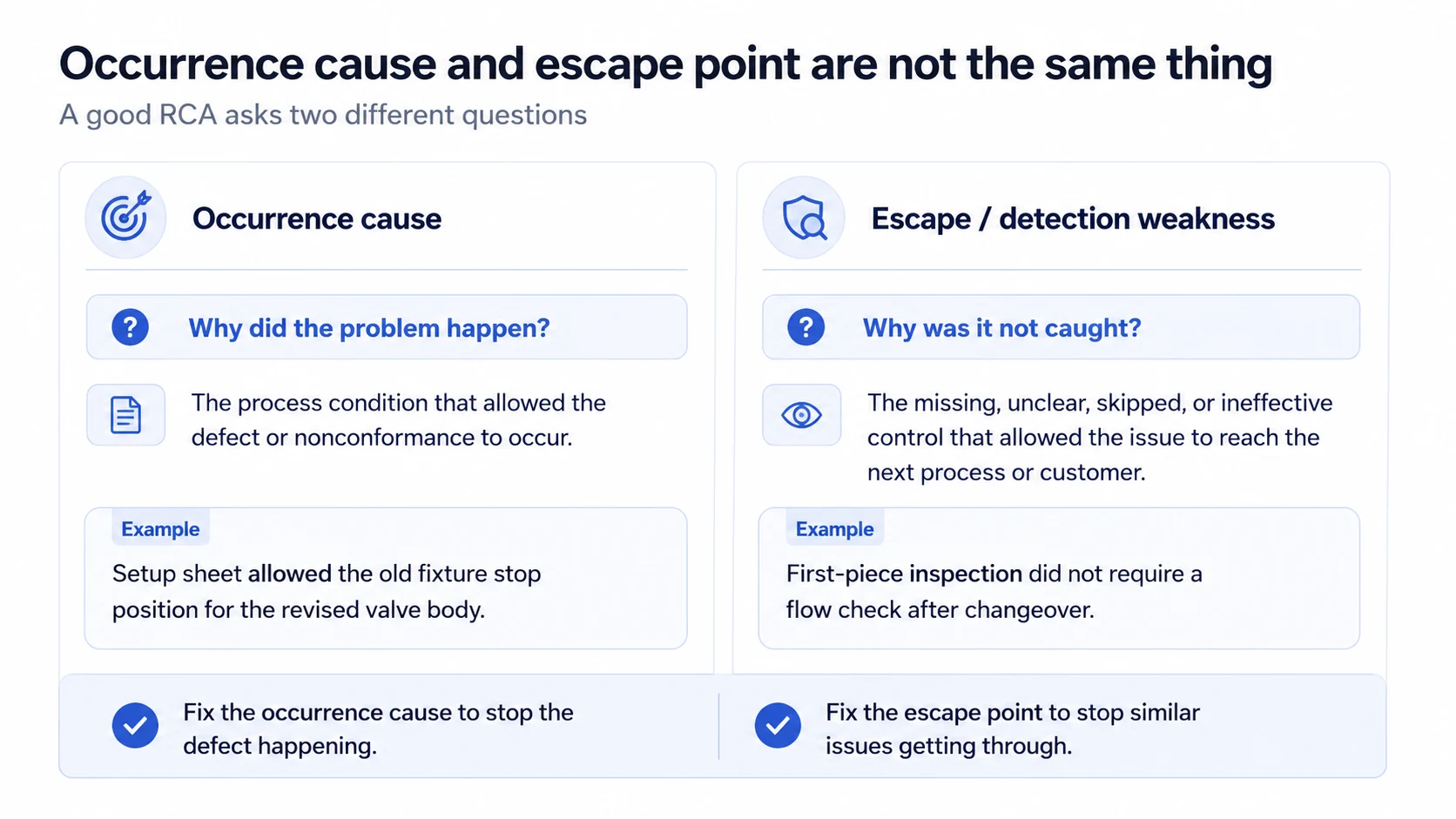
Occurrence cause
What process condition allowed the nonconformance to occur?
Use evidence from the method, equipment, material, document, setup, maintenance, measurement, or process control that created the condition.
Escape or detection weakness
What control should have detected the condition, and why did it not?
Review the inspection characteristic, sampling plan, test coverage, checklist, gauge use, review step, and release decision.
Do not merge the two conclusions
Types of root cause analysis methods used in manufacturing
The main types of root cause analysis methods organize, narrow, compare, or test possible cause paths. No method establishes cause by itself.
| Method | What it helps with | When to use it | Main limitation |
|---|---|---|---|
| 5 Whys | Tests one focused possible-cause path. | When the problem is well defined and one cause chain can be examined with evidence. | It can become narrow or opinion-based if each answer is not tested. |
| Fishbone diagram | Organizes several possible-cause categories. | When the team must widen the investigation before choosing which paths to test. | The branches remain theories until evidence is reviewed. |
| Is / Is Not analysis | Compares affected and unaffected conditions. | When the issue appears on some products, lots, machines, shifts, or time periods but not others. | It depends on accurate and complete comparison data. |
| Process observation | Compares actual floor practice with the controlled method. | When records and normal practice do not agree. | Observation becomes anecdotal unless the conditions and results are recorded. |
| Data and trend review | Identifies patterns by lot, supplier, machine, shift, timing, or failure mode. | When credible historical data exists. | Correlation and frequency do not prove cause. |
| Fault tree analysis | Maps logical combinations that can produce a complex failure. | When the issue is complex, safety-critical, or depends on several interacting conditions. | It can be unnecessarily heavy for a straightforward manufacturing issue. |
Select the method that fits the problem, then use evidence to support or rule out the resulting cause paths.
Worked manufacturing example
Final functional-test failure after changeover: a worked RCA example
This generic example shows the evidence trail from a failed functional test to a supported occurrence cause, a separate detection weakness, and a controlled handoff to corrective action.
Problem
Final functional test rejected valve assemblies after changeover because flow was below the specified minimum. The issue was found before shipment.
Requirement
The product specification requires each assembly to meet the defined minimum flow at final functional test.
Affected and suspect scope
The failed assemblies are confirmed affected. Product made since the last verified good changeover remains suspect until setup and test records are reviewed and the required functional test is complete.
Containment
Place affected and suspect assemblies on quality hold, block release, verify the last known good point, and perform the required functional test before release.
Correction and disposition
Failed assemblies remain on quality hold until an approved disposition is recorded. Any rework, scrap, or other product action is controlled in the originating NCR or equivalent record and verified before release.
Evidence reviewed
Failed assemblies, final-test records, the controlled setup instruction, fixture condition, first-piece records, calibration and master-check results, component-lot comparison, process observation, and operator and supervisor interviews.
Cause testing
| Possible cause | Evidence result | Decision |
|---|---|---|
| Test-equipment drift | The master check passed and an independent repeated test agreed with the original result. | Ruled out |
| Supplier-component variation | The same component lot was present in conforming assemblies and the component met its requirement. | Ruled out |
| Setup control allowed the previous fixture stop position | The previous stop position remained available after changeover, reproduced the functional-test condition, and matched the affected-versus-conforming difference. | Supported occurrence cause |
| First-piece control omitted functional flow verification | The released first-piece checklist did not require flow verification before continued production. | Supported detection weakness |
Supported occurrence cause
The controlled setup instruction did not distinguish the required fixture stop position after changeover, and the fixture could be locked in the previous position without a positive stop.
Escape or detection weakness
First-piece inspection verified visual and torque characteristics but did not require functional flow verification before continued production.
Linked corrective action
- revise the controlled setup instruction to identify the required stop position;
- add a physical positive stop that prevents selection of the previous position;
- add first-piece functional flow verification before batch release;
- train affected operators and supervisors after the revised controls are issued.
Verification plan
Confirm that the revised setup instruction is issued, the obsolete version is removed, the positive stop is installed, first-piece flow verification is in use, and required training is complete.
Effectiveness target
Review the defined sample of subsequent changeovers over the defined review window. Acceptance criterion: no repeat functional-test failure attributable to the same setup condition.
RCA handoff
Common RCA mistakes
| Mistake | Better practice |
|---|---|
| Starting with the preferred answer | State the requirement, actual condition, and affected and suspect scope before discussing possible causes. |
| Treating a fishbone or 5 Whys chain as proof | Use the method to organize a cause path, then test each material point with evidence. |
| Stopping at operator error | Identify what allowed the error and why the process or detection control did not prevent it. |
| Failing to compare affected and conforming conditions | Use affected-versus-conforming evidence to identify what changed and what is unique to the failure. |
| Failing to record ruled-out causes | Record the evidence and decision for each material cause so another reviewer can follow the investigation. |
| Merging occurrence and detection conclusions | State separately why the nonconformance occurred and why the expected control did not detect it. |
| Choosing corrective action before the cause is supported | Complete the material evidence checks before defining the process or control change. |
| Closing because a response or action record was opened | Approve the RCA conclusion only when its evidence and handoff are complete, and keep the linked action open until its own closure criteria are met. |
How RCA connects to NCR, 5 Whys, fishbone, corrective action, CAR, SCAR, and 8D
RCA may sit inside or link from another quality record. The record type determines what is controlled before, during, and after the cause investigation.
| Record or method | Main job | RCA connection |
|---|---|---|
| NCR | Controls the nonconformance and product decision. | Link RCA when cause investigation is needed beyond the product disposition and correction. |
| 5 Whys | Tests one focused possible-cause path. | Use it within RCA when one chain can be examined with evidence. |
| Fishbone diagram | Organizes several possible-cause paths. | Use it to widen the investigation before selecting causes for evidence review. |
| Corrective action | Changes the process or control associated with the supported cause. | RCA provides the evidence-supported cause; the corrective-action record owns implementation verification and effectiveness. |
| CAR | Formal corrective-action response requested by a customer or internal authority. | RCA supplies the cause evidence used in the requested response. |
| SCAR | Supplier corrective action request. | Use it when the supplier must investigate, respond, change its process, and provide evidence for review. |
| 8D | Structured D1–D8 response for a customer-impacting, repeated, complex, or high-risk issue. | D4 uses evidence to establish occurrence cause and escape or detection weakness; D5–D7 own corrective action, implementation, effectiveness, and prevention before D8 closure. |
When the RCA investigation is complete
RCA completion depends on what the record owns. Some procedures close the cause investigation separately from the linked corrective action; others keep one record open through effectiveness review.
- the requirement and actual condition are defined;
- affected and suspect scope is recorded;
- containment and correction records are traceable;
- material possible causes and their results are recorded;
- the supported occurrence cause is backed by evidence;
- the escape or detection weakness is recorded where relevant;
- ruled-out causes and unresolved questions are traceable;
- the conclusion has the required approval;
- the linked action has an owner, due date, and record reference.
Keep the handoff controlled
References and standards context
Use these references as background, then apply your own company, customer, product, process, supplier, and industry requirements.
This guide follows established manufacturing quality frameworks (ISO 9001, AIAG, ASQ definitions) and is reviewed internally before publishing.
This is provided for general manufacturing quality use. Adapt it to your company, customer, product, process, supplier, and industry requirements before use. It is not intended for medical device, pharma, FDA, Part 11, or validated regulated workflows.
Use the root cause analysis template
Use the matching template page when you need a controlled record for the problem, possible causes, evidence reviewed, supported occurrence cause, escape or detection weakness, linked action, review decision, and approval.