ISO 9001:2026

Written by Jason Westland · Edited by Johanna Barnett · Last updated 17 September 2026

ISO has now published ISO 9001:2026, the latest version of the quality management systems standard. This guide explains the changes from ISO 9001:2015, their practical implications, and how organizations should prepare for the transition.

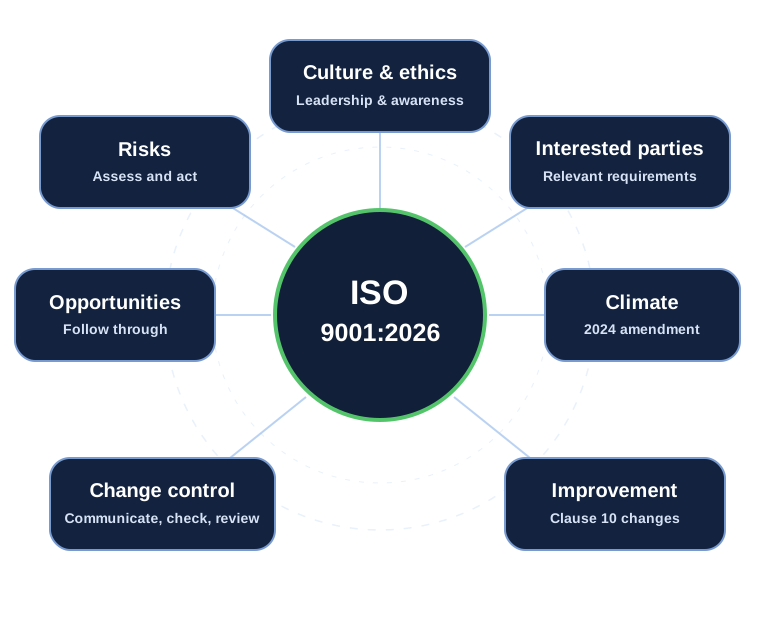
Seven ISO 9001:2026 change themes around a central ISO 9001:2026 hub

ISO 9001:2015 vs 2026: what changed

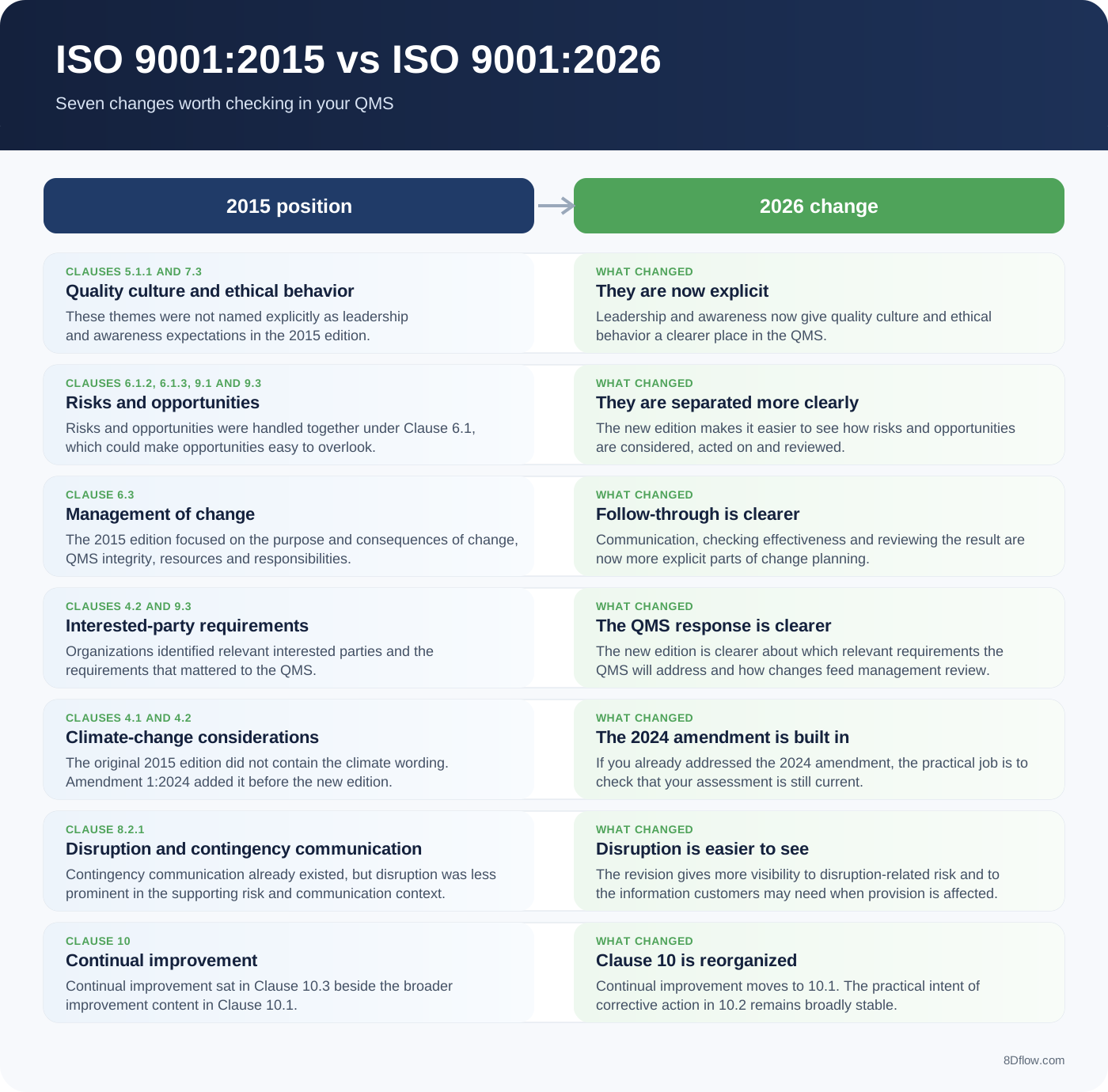
The infographic gives you the quickest view of the main changes from 2015 to 2026. It highlights the seven areas most likely to need attention in an existing QMS.

Publication status: ISO 9001:2026 was published on 16 September 2026 as Edition 6 and is now the current edition of ISO 9001.
ISO 9001:2015 versus ISO 9001:2026 infographic comparing seven important changes

2015 vs 2026 clause-by-clause comparison

Here is the detailed comparison behind the infographic, prepared from 8Dflow's review of the 2015 edition, the 2024 amendment, and the 2026 revision material. It shows what changed in each clause and what you should check in your QMS.

4.1 → 4.1 · Context

2024 amendment incorporated

What changed: The climate-change wording introduced in the 2024 amendment is now part of the base edition, and the supporting notes are broader.

What to check: If you already dealt with the 2024 amendment, check that your assessment is still current.

4.2 → 4.2 · Interested parties

Expanded

What changed: The new edition is clearer about deciding which relevant interested-party requirements the QMS will actually address.

What to check: Be able to explain which requirements matter to the QMS and what you do about them.

4.3 → 4.3 · QMS scope

No material change

What changed: The intent of the scope requirement is substantially unchanged.

What to check: Keep the existing scope if it still describes the organization and its QMS accurately.

4.4 → 4.4 · Quality management system

Retitled / editorial

What changed: The section is reorganized, but the underlying process-management expectations remain familiar.

What to check: Check old cross-references if your documents rely on the previous item lettering.

5.1.1 → 5.1.1 · Leadership and commitment

New + restructured

What changed: Quality culture and ethical behavior are now explicit themes, alongside clearer emphasis on opportunities and continual improvement.

What to check: Look at what leaders actually say, decide, reinforce, and review. A new procedure is not the point.

5.1.2 → 5.1.2 · Customer focus

No material change

What changed: No significant change in intent was identified.

What to check: No transition action is needed simply because the edition changed.

5.2 → 5.2 · Quality policy

Retitled / reworded

What changed: The section is reorganized, but the basic purpose of the quality policy remains the same.

What to check: Do not rewrite a suitable policy unless the revision exposes a genuine gap.

5.3 → 5.3 · Roles and authorities

Reworded / split

What changed: Some responsibilities are rearranged and the wording around QMS integrity and improvement is updated.

What to check: Make sure responsibilities are still clear, assigned, and understood.

6.1.1 → 6.1.1 · Planning

Clarified

What changed: The planning logic is reordered and the link with continual improvement is clearer.

What to check: Keep your current approach if it works, but make sure it leads to useful decisions and follow-through.

6.1.2 → 6.1.2 · Risks

Expanded

What changed: Risk analysis and evaluation are more explicit, and the response should remain proportionate to the QMS and its results.

What to check: Check that important risks are identified, evaluated, acted on, and reviewed.

6.1.2 → 6.1.3 · Opportunities

New subclause

What changed: Opportunities are separated from risks instead of sitting inside the same planning thread.

What to check: Make worthwhile opportunities visible enough to follow from identification through action and review.

6.2 → 6.2 · Quality objectives

Mostly editorial

What changed: The section is reordered and the wording around documented information is aligned with the rest of the standard.

What to check: Update internal references only where the new structure makes them stale.

6.3 → 6.3 · Planning changes

Expanded

What changed: Communication, checking effectiveness, and reviewing the result are now clearer parts of change planning.

What to check: If these are missing from change control today, add them to the way changes are planned and closed out.

7.1.1–7.1.4 · Resources and work environment

Mostly unchanged

What changed: The core requirements remain familiar, while the notes are modernized, including examples such as remote or hybrid work.

What to check: Do not create new controls just because an example in a note has changed.

7.1.5 → 7.1.5 · Monitoring and measuring resources

Clarified / retitled

What changed: The wording on measurement traceability is clearer and the documented-information terminology is updated.

What to check: Check that calibration or verification status and safeguards are still clear in practice.

7.1.6 → 7.1.6 · Organizational knowledge

Slightly expanded

What changed: The new wording puts more emphasis on retaining, using, and sharing the knowledge the QMS needs.

What to check: Make sure important knowledge is available and used, not simply stored somewhere.

7.2 → 7.2 · Competence

No material change

What changed: The wording changes do not materially alter what an organization needs to demonstrate about competence.

What to check: Keep existing competence controls if they are working.

7.3 → 7.3 · Awareness

New element

What changed: Awareness now includes quality culture and ethical behavior.

What to check: Check whether people understand what those expectations mean in their own work.

7.4–7.5 · Communication and documented information

Mostly editorial

What changed: Communication is largely unchanged, while documented-information wording is made more consistent across the edition.

What to check: Avoid a mass rewrite unless old wording or references are genuinely confusing.

8.1 → 8.1 · Operational planning and control

Restructured

What changed: The section is reorganized, including clearer alignment with the controls for externally provided processes in Clause 8.4.

What to check: Check internal references and make sure relevant external processes are not falling through gaps.

8.2.1 → 8.2.1 · Customer communication

Clarified / broadened

What changed: Communication about contingency action is clearer when disruption affects the provision of products or services.

What to check: Check that customers receive the information they need when disruption affects delivery or service.

8.2.2–8.2.4 · Requirements for products and services

Mostly clarified

What changed: The wording is modernized, including clearer communication when relevant requirements change.

What to check: Make sure changes reach the people or external parties who actually need to know.

8.3 → 8.3 · Design and development

Clarified / minor extensions

What changed: The guidance better reflects iterative design and clarifies some information needed for intended use.

What to check: Check that your design controls work for the way design is actually carried out in your organization.

8.4 → 8.4 · Externally provided processes, products, and services

Slightly broadened

What changed: The wording is broader and more consistent about externally provided processes and provider interactions.

What to check: Check that all relevant external processes are controlled, not only work formally called outsourced.

8.5 → 8.5 · Production and service provision

Mostly editorial

What changed: The core requirements are carried forward with some reorganization of evidence and traceability wording.

What to check: A wholesale process rewrite should not be needed.

8.6 → 8.6 · Release

No material change

What changed: The wording around release evidence is updated without adding a significant new control.

What to check: Keep existing release records if they already show conformity and authorization clearly.

8.7 → 8.7 · Control of nonconforming outputs

Reworded, same intent

What changed: The practical intent remains broadly the same, with additional explanation appearing in the supporting guidance.

What to check: Existing NCR controls should remain suitable if they already control disposition, correction, and verification.

9.1 → 9.1 · Monitoring, measurement, analysis, and evaluation

Clarified / aligned

What changed: Evaluation of risks and opportunities is separated to match Clause 6, and the customer-satisfaction wording is simplified.

What to check: Make sure performance review follows both risks and opportunities where they matter.

9.2 → 9.2 · Internal audit

Minor addition

What changed: Each audit is expected to have a clear objective, while the overall audit-program approach remains familiar.

What to check: If your audit plans show only scope and criteria, add the purpose of the audit as well.

9.3 → 9.3 · Management review

Expanded / reordered

What changed: Changes in interested-party needs and action on opportunities are more visible in management-review inputs.

What to check: Check that management review covers these topics when they are relevant to the QMS.

10.3 → 10.1 · Continual improvement

Restructured

What changed: Continual improvement moves to Clause 10.1 and absorbs some of the previous general-improvement content.

What to check: Update old clause references, but leave effective improvement processes alone.

10.2 → 10.2 · Nonconformity and corrective action

Reworded, same intent

What changed: The core corrective-action logic remains materially stable despite wording changes.

What to check: Do not invent extra fields just because the edition changed. Check that the process still deals with recurrence and effectiveness.

What the changes mean in practice

These are the areas where I would expect a quality manager to spend time. If your current system already handles one well, the change may need little more than confirmation and a small update.

Quality culture and ethical behavior

Do not start by writing a new 'quality culture procedure'. Start with leadership behavior, decisions, communication, and what people actually see reinforced in day-to-day work.

Risks and opportunities

If opportunities exist only as a token column in a risk register, this is the area to tighten. Important opportunities should be visible, acted on, and reviewed rather than simply recorded.

Management of change

Most organizations can strengthen the change process they already have. The main question is whether communication, effectiveness checking, and review of the result are built into the change rather than added afterwards.

Interested parties

A stakeholder list on its own is not very useful. Be clear about which external or internal requirements matter to the QMS and how you notice when those requirements change.

Climate change

If you implemented the 2024 amendment properly, do not repeat the exercise for appearance's sake. Check that the assessment is still current and move on.

Disruption and contingency communication

This does not automatically mean you need a large business-continuity program. Check that relevant risks, contingency actions, and customer communication fit together when provision is disrupted.

Clause 10 restructuring

This is mostly a housekeeping issue for a mature QMS. Update stale clause references where they could confuse people, but keep improvement and corrective-action processes that already work.

What has not changed

Much of the 2015 system carries forward. That matters because good processes can stay in place instead of being rebuilt just to look different.

  • The management-system structure remains familiar across Clauses 4 to 10.
  • Customer focus, competence, documented information, operational control, internal audit, and management review remain core QMS elements.
  • Control of nonconforming outputs in Clause 8.7 remains materially stable in practical terms.
  • Nonconformity and corrective action in Clause 10.2 remains materially stable in its core intent.
  • ISO 9001 still does not prescribe a particular root-cause method such as 5 Whys, Fishbone, or 8D.
  • An effective process does not need to be redesigned simply because a clause was reworded or moved.

Who needs to transition to ISO 9001:2026?

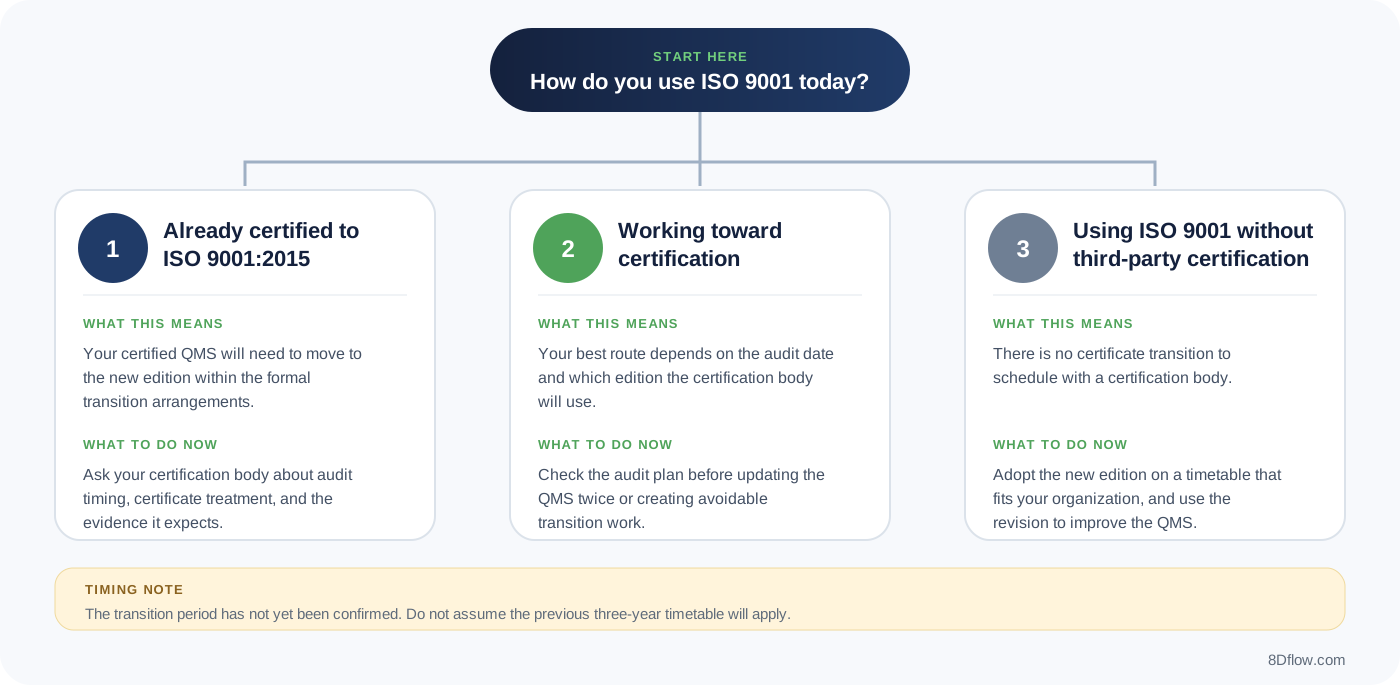
Your next step depends on how you use ISO 9001 today. Start with the option that matches your organization.

Three ISO 9001:2026 transition paths for certified, certification-seeking, and non-certified organizations

ISO 9001:2026 transition timeline

Global ACI has set a three-year transition period for accredited certification covered by its Multilateral Recognition Arrangement. These are the dates that matter most to certified organizations.

16 Sep 2026

ISO 9001:2026 published

ISO published Edition 6 and withdrew ISO 9001:2015 and its 2024 amendment from the current-edition position.

31 Mar 2028

New accredited certifications move to 2026

From this date, new and initial accredited certifications covered by the Global ACI MRA transition requirements may only be issued to ISO 9001:2026.

During the transition

Existing certificates can move during a normal audit cycle

The transition may be completed during a scheduled surveillance audit, a recertification audit, or a separate transition audit.

30 Sep 2029

The transition period ends

Organizations with accredited ISO 9001:2015 certification under the applicable Global ACI MRA arrangements must complete the transition by this date.

Important: Global ACI's transition requirements are mandatory for Global ACI MRA accreditation body signatories and their accredited certification bodies within the applicable scope. Your certification body should confirm how the timetable applies to your certificate and audit cycle.

Source: Global ACI transition requirements for ISO 9001:2026.

How to transition to ISO 9001:2026

A sensible transition is a small change project: understand the revision, find the gaps, fix what matters, then prove the changes are working.

1

Get the final standard

Use the published ISO 9001:2026 edition and current transition guidance as the basis for the work.

2

Map the changes to your QMS

Work through the changes and mark the ones that actually affect your processes, responsibilities, records, or management practices.

3

Write down the real gaps

Separate genuine gaps from wording changes that do not alter what your organization needs to do.

4

Make the changes

Assign owners and dates, then update the affected controls, documents, communication, or training.

5

Check that they work

Verify that the changes are in use and that they have achieved the intended result before closing the action.

6

Agree certification timing

Plan the transition audit with your certification body so it fits your certification cycle and is completed before 30 September 2029.

Free PDF

Free ISO 9001:2026 transition checklist

Use the checklist to keep the transition organized without turning it into a paperwork exercise. You can work from the page below or download the printable PDF.

Download free checklist

Confirm the basis

  • Use the published ISO 9001:2026 edition as the source of truth for the requirements.
  • Use the current Global ACI transition requirements for accredited certification timing, and confirm how they apply to your certification cycle with your certification body.
  • Check that the scope of the QMS still reflects the organization as it operates today.

Review the changes

  • Decide what the new quality-culture and ethical-behavior emphasis means for leadership and awareness in your organization.
  • Check that risks and opportunities are both evaluated, acted on, and followed through where they matter.
  • Check how organizational changes are communicated, verified, and reviewed after implementation.
  • Confirm that the 2024 climate-change amendment has already been addressed and that the assessment is still current.
  • Check which interested-party requirements the QMS actually addresses and whether that is clear in practice.
  • Check customer communication for disruptions that could affect products or services.

Update only what needs to change

  • Keep processes and controls that already work. Do not rewrite them just because wording or clause numbering changed.
  • Update clause references where renumbering or restructuring makes them stale or misleading.
  • Update awareness or training only where the revision changes what people need to understand or do.
  • Add missing change-control elements such as communication, effectiveness checking, or review of results.
  • Give each internal audit a clear objective where this is not already evident.

Check readiness

  • Confirm that revised controls are actually in use before closing transition actions.
  • Use internal audit or another suitable check to verify the changes that matter to your QMS.
  • Use management review to deal with material gaps, unresolved actions, and readiness where appropriate.
  • Agree the transition-audit approach and timing with your certification body early enough to complete the move before 30 September 2029.
  • Keep transition records proportionate to the size, complexity, and risk of the QMS.

ISO 9001 versions and revision history

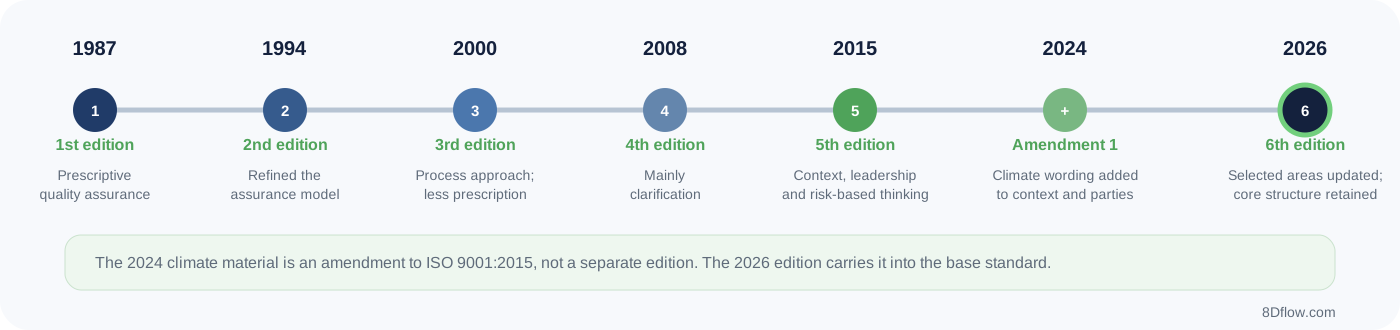
ISO 9001 has changed several times since 1987, but each edition has built on what came before. The timeline puts the 2026 revision in that context.

Timeline of ISO 9001 editions from 1987 to 2026, including the 2024 climate amendment

How much work will the transition take?

For a mature QMS, the transition should be manageable. The workload rises when the revision exposes weaknesses that were already there.

Likely lower effort

01

Your 2015 QMS is already effective, the 2024 climate amendment is in place, risks and opportunities are handled properly, and change control is sound.

What that usually means: You are likely looking at a focused gap review, a small number of updates, some awareness work, clause-reference cleanup, and internal verification.

Likely moderate effort

02

Opportunities are weakly handled, change control is light, awareness needs work, or different sites and functions use different practices.

What that usually means: Expect more coordinated actions, communication, internal-audit attention, and management-review follow-through before the transition is complete.

Likely higher effort

03

The current QMS already has unresolved weaknesses, relies heavily on old clause wording, or has fragmented controls across sites or functions.

What that usually means: Use the revision as a controlled improvement project, but keep existing QMS weaknesses separate from changes caused by the new edition.

Common transition mistakes

Six tips for avoiding the most common ISO 9001:2026 transition mistakes.

Rewriting the whole QMS before you know the gaps

Better approach: Compare the editions first. Keep processes that still work and change only what genuinely needs attention.

Treating every wording change as a new requirement

Better approach: Separate real changes in intent from editorial wording, moved content, notes, and terminology changes.

Using draft commentary as the source of truth

Better approach: Use the published standard and authoritative sources for transition arrangements.

Treating climate change as entirely new in 2026

Better approach: Remember that the climate wording already arrived through the 2024 amendment.

Creating a standalone quality-culture procedure

Better approach: Look first at what leaders do, what they communicate, and what behavior people see reinforced.

Updating documents and assuming the work is finished

Better approach: Check that the changed controls are actually being used and understood before you close the transition action.

Questions that usually come up during transition

These questions cover practical situations that are not answered elsewhere on the page.

What if our certification audit is already booked?

Keep the booking, but speak to your certification body before changing the audit plan. Ask which edition the audit will use, whether the timing creates duplicate work, and what evidence it expects during the transition.

Do we need to train every employee on the new edition?

No. Match the communication or training to the change. Many people may only need a short awareness update, while people whose process or responsibility changes may need something more specific.

Can we keep old ISO 9001:2015 clause numbers in our internal documents?

Yes, if they are not causing confusion. Update references where content has moved or where old numbering could mislead users, auditors, or cross-references. There is no value in rewriting sound documents just to make them look new.

When does the ISO 9001:2026 transition period end?

For accredited certification covered by the Global ACI MRA transition requirements, the transition period ends on 30 September 2029. Confirm the timing of your own transition audit with your certification body because it still needs to fit your certification cycle.

Official sources and where to get the standard

Use the official standard for the requirements and authoritative sources for certification timing. Avoid unofficial copies and old transition summaries.

This is an independent 8Dflow guide. It explains the revision in practical language; the official ISO standard remains the source for the requirements.